Skip to content
HoReCa Shop
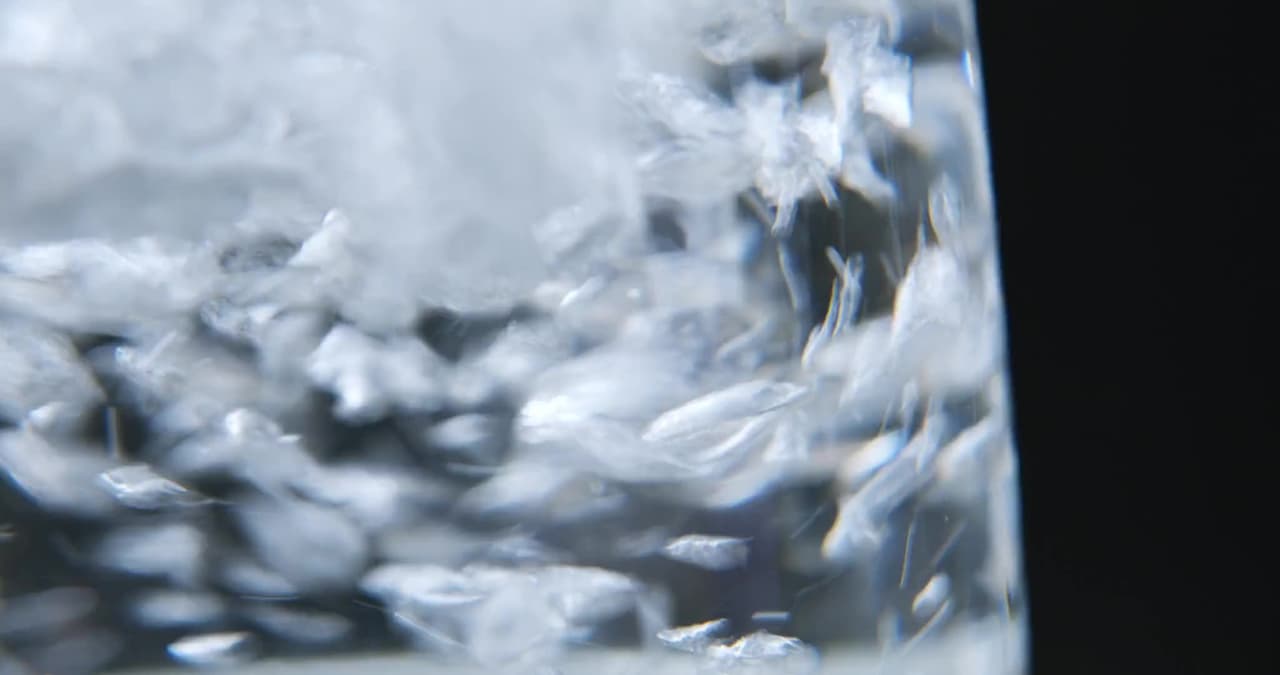
Macro shot of crystal-clear water with rising bubbles and espresso extraction

Magnesium Mineralized Water

BWT: perfect water. Magnesium for your health and ideal taste.

Water mineralisation technology from BWT — a company that describes itself as Europe's leading water technology group. Protection for your equipment, care for the planet and a new standard for every drink you serve.

The Magnesium power

More than just filtration.

A conventional filter only takes something away. BWT's patented magnesium technology goes one step further: the ion exchanger is charged with magnesium, so as the calcium that forms limescale is bound and removed, magnesium is released into the water in exchange.

  • Coffee taste

    In a sensory panel study led by Prof. Chahan Yeretzian at ZHAW and sponsored by BWT, shifting the brewing water's mineral balance towards magnesium significantly reduced bitterness and astringency. Mineral content is a genuine variable in extraction, which is why speciality roasters specify their water.

  • Minerals, not just filtration

    BWT publishes a magnesium release of roughly 25–30 mg per litre for its mineralising cartridges, and positions the result as a contribution to your daily magnesium intake. Magnesium is an essential dietary mineral, and water is one of the ways people take it in.

  • Protection

    Calcium and carbonate hardness are what turn into limescale inside boilers and heat exchangers. Exchanging calcium for magnesium means the scale formers leave without stripping the water down to a flat, empty mineral profile.

Mains water in

Ca²⁺HCO₃⁻

Carries calcium and carbonate hardness — the source of limescale.

BWT cartridge
  1. 1Pre-filtration holds back particles and turbidity.
  2. 2Magnesium technology: calcium is bound and magnesium released in exchange.
  3. 3Activated carbon removes chlorine, odours and off-flavours.

Mineralised water out

Mg²⁺

Low in limescale formers, enriched with magnesium.

Simplified diagram — BWT's own cutaway shows up to five filtration stages. The actual layout, and the bypass setting on the filter head, depend on the cartridge model and your local water analysis.
BWT water+more

The secret behind your venue's success.

Coffee is over 90% water. Which cartridge you fit decides how your espresso tastes — and how often your technician visits.

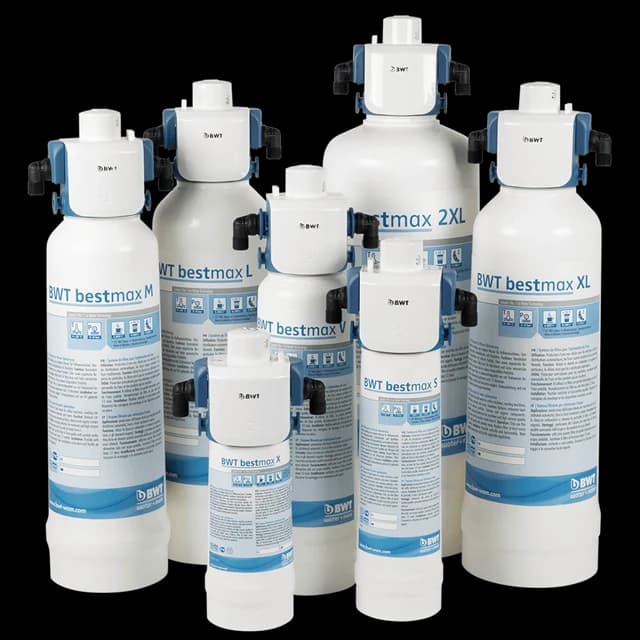
BWT bestmax cartridge range, sizes X to 2XL, each with a besthead connector
The all-rounders

bestmax

The workhorse of the range. Five-stage filtration with a high-performance ion exchanger, covering the widest set of applications at the lowest cost per litre.

  • Five stages, from pre-filter to fine filter
  • Coffee, ovens, ice makers, dishwashers
  • Listed here in L, XL and 2XL
Request a quote
The taste experts
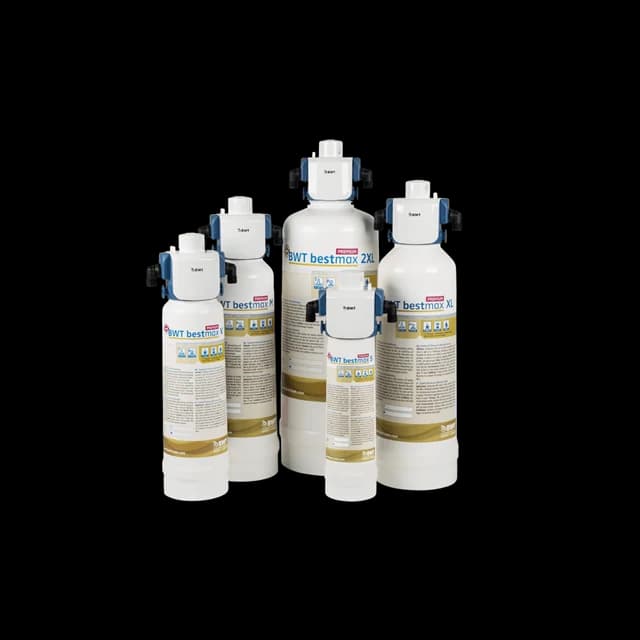
BWT bestmax PREMIUM cartridge range, each unit carrying the gold PREMIUM banding and a besthead connector
Magnesium mineralisation

bestmax PREMIUM

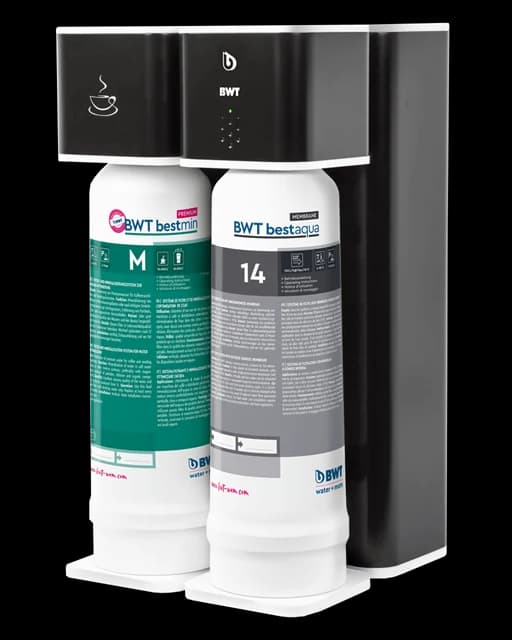
BWT's taste line. Removes limescale formers and mineralises the water with magnesium — the cartridge BWT markets for optimised coffee extraction and crema.

  • Patented BWT Magnesium Technology, per BWT
  • For coffee, espresso, vending and cold drinks
  • Rated on total hardness; bypass 0–3 on the head
Request a quote
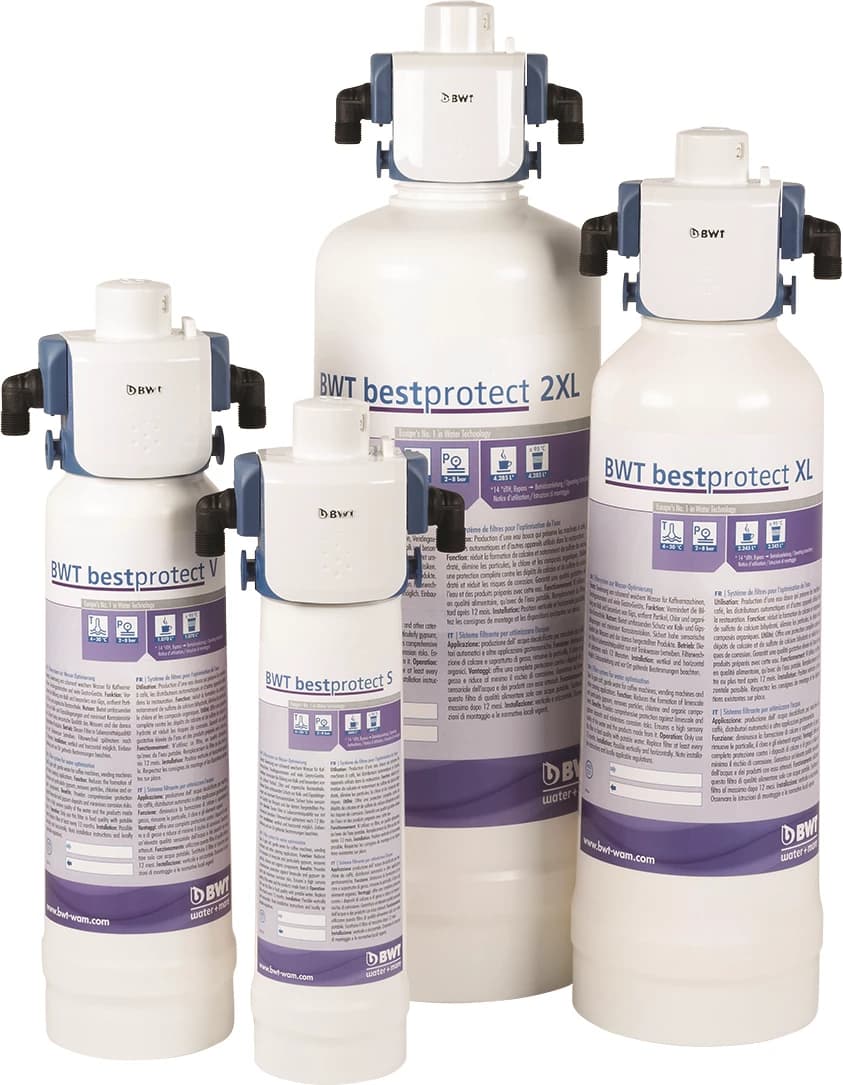
BWT bestprotect cartridge range with its violet banding, each with a besthead connector
The protectors

bestprotect

For difficult water chemistry — where sulphate or gypsum is present, or where corrosion and pH are the risk rather than hardness alone.

  • Protection against limescale and gypsum
  • Works without a bypass setting
  • Vertical installation
Request a quote
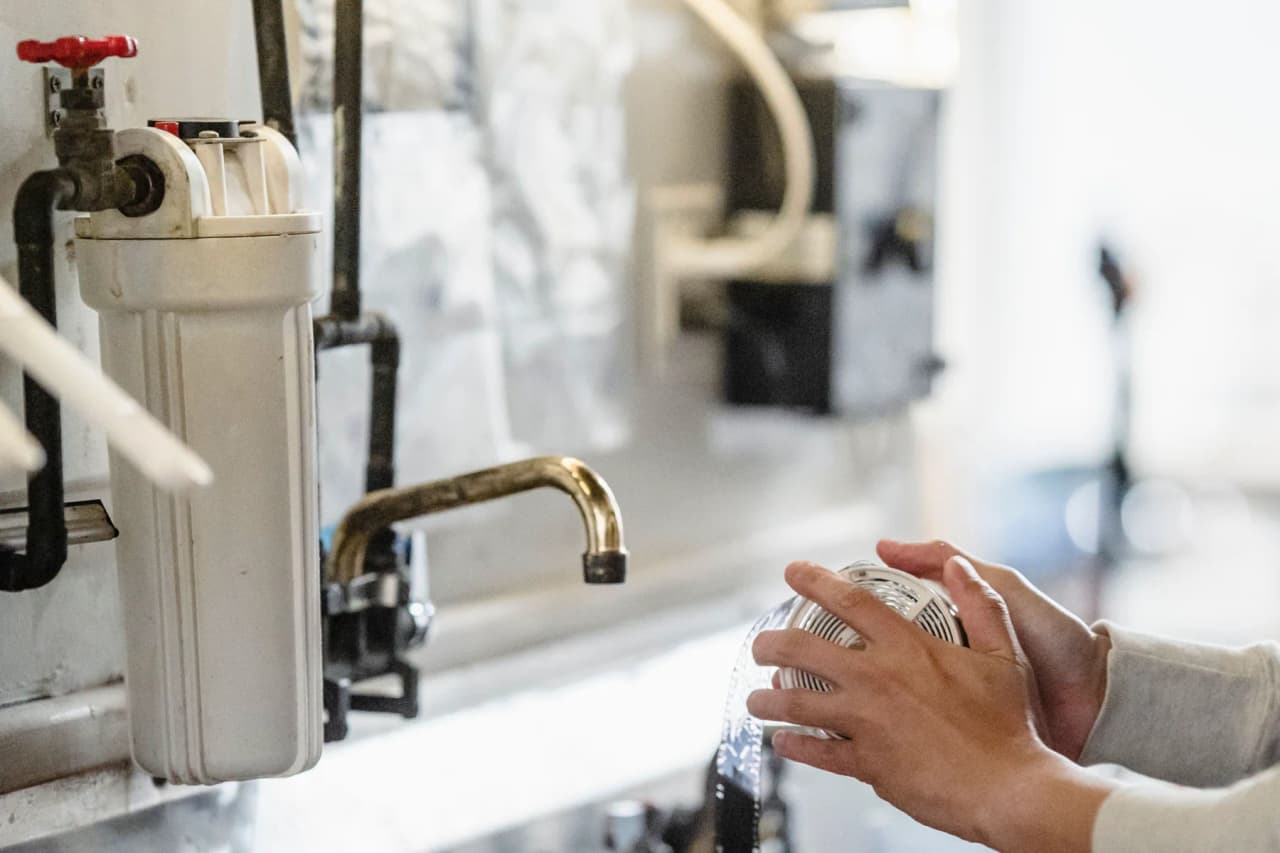
Hands holding a replacement filter cartridge beside a wall-mounted filter housing and tap

Water treatment is the cheapest service you will ever buy.

Limescale is the single most common cause of failure in professional coffee equipment. Carbonate hardness in the mains supply precipitates as scale the moment the water is heated, coating boilers, heating elements and heat exchangers. Scale is a poor conductor of heat, so as the layer builds, the same drink costs more energy and the boiler works harder to hold temperature — which is why brew temperature drifts and shot times start to wander long before anything actually breaks.

The commercial argument is simple. A replacement cartridge costs a fraction of a descaling service, and a small fraction of a boiler or heat-exchanger replacement. Manufacturers of espresso machines, combi ovens and ice makers also routinely make correctly specified water treatment a condition of warranty — meaning scale damage on an unfiltered machine is often not a warranty claim at all.

The right choice depends on your water and on the machine, not on the price list. Where hardness is the problem and cost per litre matters, bestmax is the all-rounder — and the line BWT also specifies for combi ovens, ice makers and dishwashers. Where the raw water carries sulphates as well as carbonates, ordinary decarbonisation leaves gypsum scale and a pH drop behind, and bestprotect is the answer; it is designed to work without a bypass and mounts vertically. And where you are selling the taste of the coffee, bestmax PREMIUM mineralises with magnesium — BWT lists it for coffee, espresso, vending and cold drinks rather than for steam equipment. Send us your water analysis, or just your address, and we will size it for you.

Two hands passing a glass of filtered water across a kitchen counter
For You and Planet Blue.

Mission: a clean planet.

BWT frames its mission as changing the world sip by sip — replacing single-use bottles with water that is already in the building, delivered through a pipe that is already there.

Filtered mains water needs no bottling plant, no pallets, no delivery van and no recycling stream. For a business, the environmental case and the commercial case point in exactly the same direction: fewer deliveries, less storage, less waste to handle.

The scale of the problem, as BWT states it:

1.2 million
Plastic bottles produced worldwide every minute and transported around the globe
2050
The year by which there will be more plastic than fish in the oceans
+350%
The projected increase in the transport of goods

Figures above are BWT's published statements about the global plastic problem, not measurements of an individual installation. We are happy to calculate the bottles, deliveries and storage your own site would actually avoid.

The engineering

Built to be easy to live with.

In a working kitchen, elegance is measured in minutes. BWT's professional range is designed so a cartridge change is a short job, not a service call.

  • One head for the whole range

    BWT states that the besthead FLEX filter head fits every BWT water+more filter cartridge, so you can move up or down a size as consumption changes without touching the plumbing. Note that 2XL wall installations need an additional retaining-bracket extension.

  • Bypass adjustment

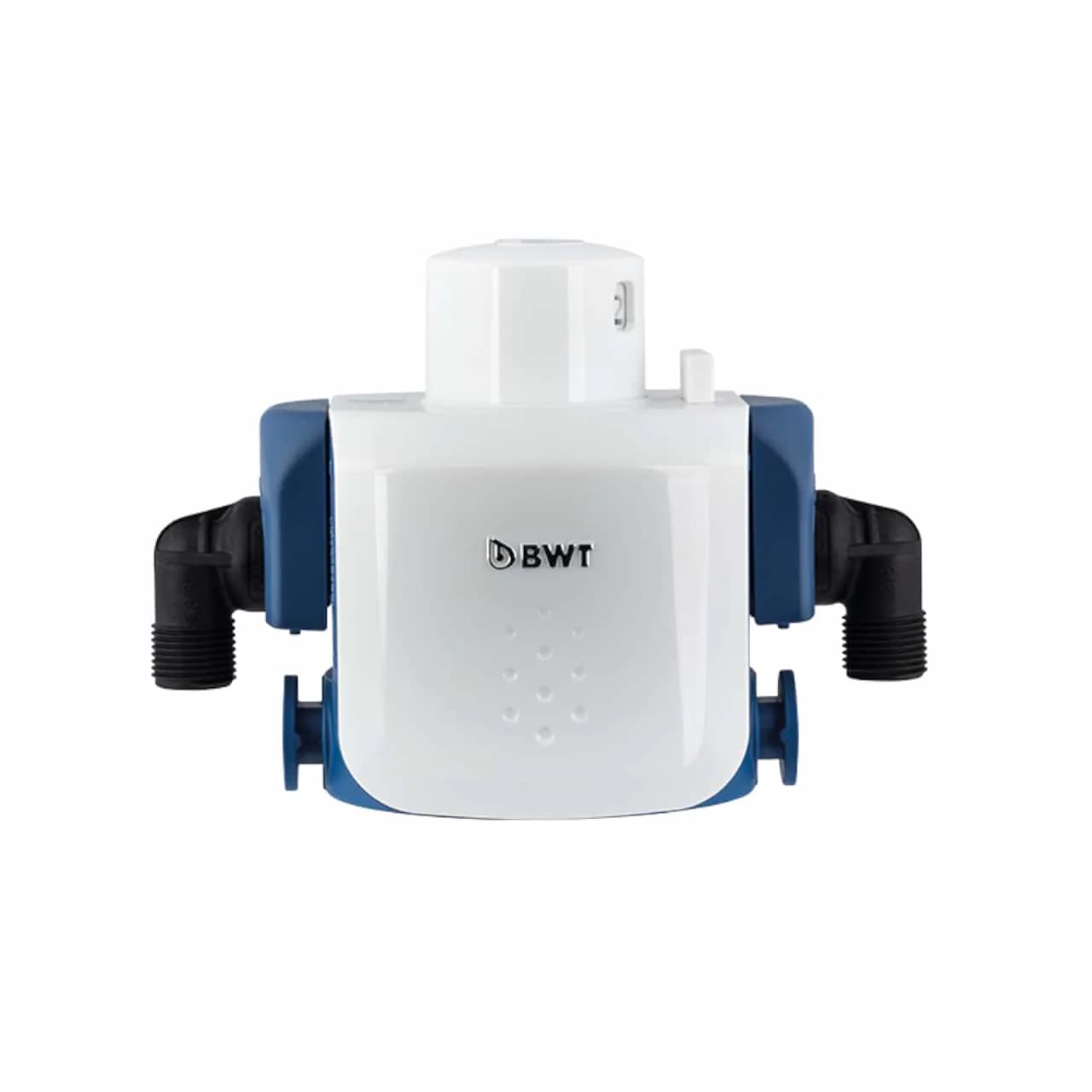
    The blend valve sits on the filter head, with settings 0 to 3. It lets a controlled share of raw water rejoin the filtered stream, trading residual hardness against cartridge life. The right setting is prescribed by your hardness band and application — it is not a free choice. Some cartridges, such as bestprotect, are designed to work without a bypass at all.

  • Backflow protection built in

    The besthead FLEX carries two DVGW-compliant non-return valves, preventing backflow into the mains or into the cartridge, plus a venting valve and tool-free FLEX Insert connectors that remove the need for double nipples and transition fittings. Mounting orientation depends on the cartridge: bestmax can go horizontal or vertical, bestprotect is vertical only.

BWT besthead filter head with its bypass dial and threaded connections
Expert answers

Questions and answers about BWT water treatment.

How do I calculate a cartridge's service life?
BWT publishes capacity tables rather than a formula, but the logic behind them is simple: an ion exchanger holds a fixed exchange capacity, so litres multiplied by hardness stays constant for a given size and bypass setting. Take any row of the table, multiply it out, then divide that constant by your own hardness to get litres — and divide litres by your daily draw to get days. A cartridge rated 1,440 litres at 20° carries a constant of 28,800, which at 17° is roughly 1,690 litres, or about ten weeks at 25 litres a day. Two limits override the arithmetic: BWT states capacities may deviate by around ±5% with local water quality and flow, and a cartridge should be replaced within its maximum standing time even if litres remain. One trap to avoid — bestmax is rated on carbonate hardness while bestmax PREMIUM is rated on total hardness, so the two tables are not interchangeable. Fitting a flow meter on the filter head turns the changeover date from an estimate into a measurement.
What makes magnesium mineralisation unique?
An ordinary scale filter answers one question: how do we stop calcium turning into limescale? BWT's patented magnesium technology answers a second one — what should replace it. Conventional softening exchanges calcium for sodium or hydrogen, which protects the machine but strips the water of the mineral structure extraction depends on. The bestmax PREMIUM cartridge exchanges calcium for magnesium instead, so the filtrate is re-mineralised on the way out. BWT cites a sensory cupping panel led by Prof. Chahan Yeretzian at ZHAW, which it sponsored, reporting that shifting the mineral balance towards magnesium significantly decreased bitterness and astringency. Note that BWT publishes this as a significant reduction, not as a percentage. The practical rule for an operator: both lines protect the equipment, but only the magnesium line is also working on the cup — so specify it for the espresso machine your reputation rides on, and the standard line for ovens, ice makers and dishwashers.
Do BWT filters need servicing?
Not in the way a machine has a service contract. The routine is to replace the cartridge when its capacity is used up or when its maximum standing time is reached — whichever comes first — and to flush the new cartridge before putting it into production, following the instructions supplied with it. The filter head itself stays in place, which is why a changeover is a short job rather than a call-out. The standing-time limit matters: even a cartridge that has not reached its litre capacity should be changed on schedule, because filter media are not intended to stand in water indefinitely. That is a hygiene limit, not a capacity one.
How can I check my water hardness myself?
Three practical routes. The quickest is a test strip: dip, wait, and read the hardness off the colour scale. The most useful for sizing is a titration kit, because it reads carbonate hardness directly — and carbonate hardness, not total hardness, is what the bestmax capacity tables are indexed on. The easiest is simply to ask: your water utility publishes hardness per supply zone, and it is usually stable enough to size a filter from. Whichever route you take, tell us which value you measured and in which unit — °dH, °KH or ppm CaCO₃ — because reading a carbonate figure off a total-hardness table is the most common way a cartridge ends up mis-sized.
Free consultation

Ready to improve your water?

Request a free cartridge service-life calculation for your location and get a consultation with our engineer.

Where will the system be used?

By submitting this form you agree that we may contact you about your enquiry. We do not share your details with third parties.